
Last reviewed: 13 November 2026
EV battery health is how much energy the battery can still hold compared with when it was new, shown as a percentage called state of health. A battery at 90% holds about nine-tenths of its original charge, so the car’s range on a full battery drops by about the same share. You can check it four ways: the car’s own screen or app, a phone app on the diagnostic port, a dealer’s battery check, or an independent test such as Aviloo’s, which gives you a certificate. Most battery warranties promise at least 70% for around eight years. We check the battery on every EV and hybrid inspection, and it’s the first thing we’d look at on a used EV.
Before you read on: this is general information about used EV and hybrid batteries as it stood in November 2026, not mechanical or financial advice. Warranty terms change, so check the maker’s current terms for the exact car, using its VIN. We run InspectCar, a mobile pre-purchase car inspection service, so we have an interest in what you decide.
What EV Battery Health Means
EV battery health is the share of its original capacity a battery can still hold. A new battery starts at 100%, and years of charging and hot summers take a little off. That percentage, the battery state of health, is the number that matters, because it decides how far the car goes on a full charge.
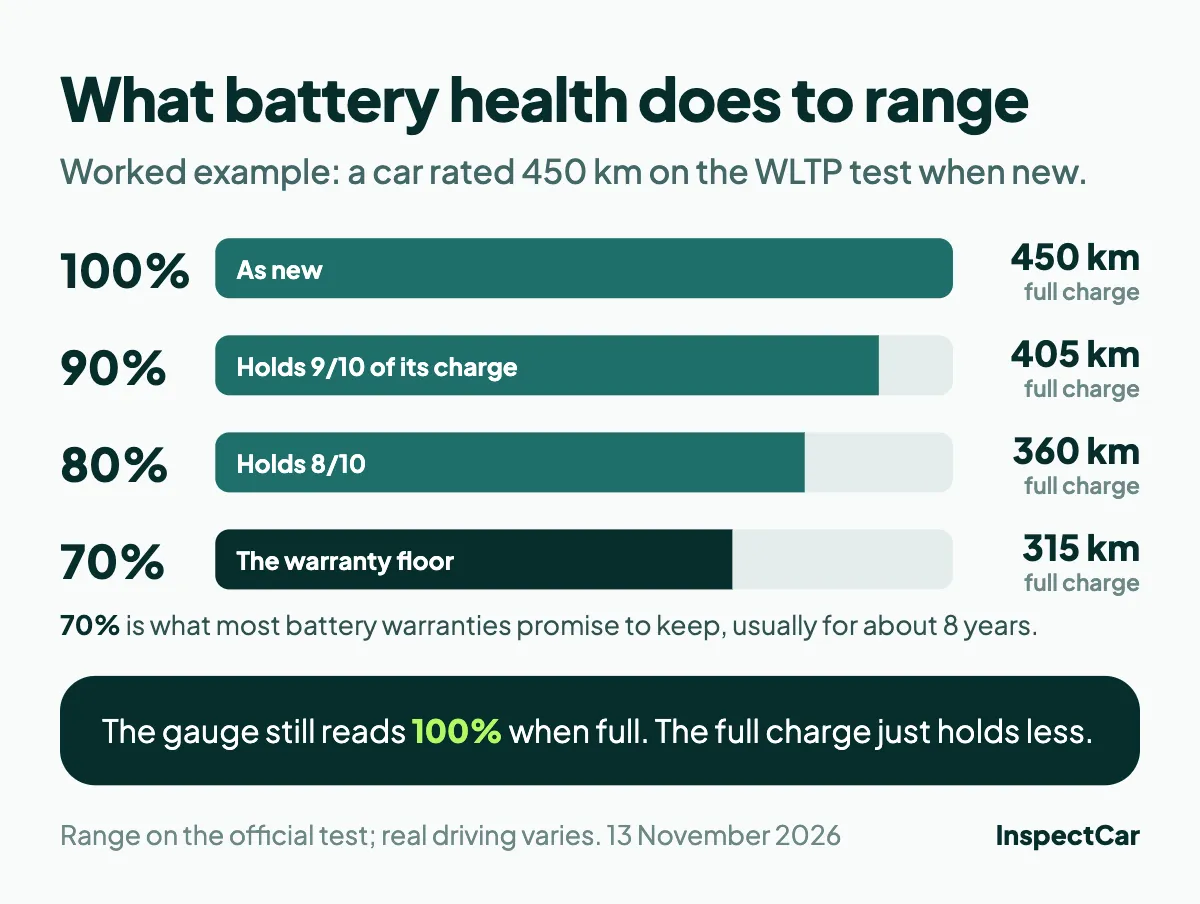
Think of an old phone. When it was new it lasted two days, and now it needs charging by dinner. The screen still says 100% when it’s full, but 100% now holds less energy than it used to. An EV battery works the same way: the gauge still fills to 100%, but a battery at 85% health holds about 15% less, and the range drops with it.
Say a car was rated for 450 km on the official WLTP test when it was new. At 90% EV battery health, a full charge is good for about 405 km on the same test, and at 80%, about 360 km. Real driving, hills, heat and the air conditioning change the actual number, but the share lost stays roughly the same.
How EV Battery Health Is Measured
There are five ways to find out, from a quick look to a certificate. The first two cost nothing but give an estimate. The last three are the ones to rely on before you pay.
1. The car’s own screen or app
Some EVs show battery health in a service menu or in the maker’s app. It’s a useful start, but not every model shows it, and a figure on the seller’s phone is hard to check.
2. A phone app on the diagnostic port
A plug-in reader and a phone app can show the estimate the car’s own computer keeps. That’s fine for a first look, but results depend on the app and the model, so treat the number as a guide, not proof.
3. A dealer’s battery health check
Some makers run battery health checks at their dealers, and those checks can keep the warranty going. Toyota, for example, extends its hybrid and EV battery cover to up to 10 years when the owner has an annual battery health check and logbook servicing done at Toyota. A used Toyota with every check on record comes with evidence and extra cover.
4. An independent battery test
An independent test measures the battery itself and gives you a certificate to keep. Aviloo says its certificate gives a diagnosis of the battery in three minutes, independent of the car’s maker. The test we use reports the battery state of health as a percentage, compares it with similar cars and estimates real-world range, and it works on the models Aviloo supports. This is the EV battery testing to ask for before you hand over the money.
5. The warranty and the service records
Check how much battery warranty is left, and whether the servicing kept it valid. Most EV battery warranties run around eight years, and the records show whether anyone checked the battery along the way.
What EV Battery Health Is Normal for a Used Car?
There’s no official pass mark, but the warranties set a floor: most promise the battery will keep at least 70% of its capacity for around eight years. Tesla’s Australian warranty covers the battery for 8 years or 160,000 km on the rear-wheel-drive Model 3 and Model Y, and 192,000 km on the long-range and performance versions, with at least 70% capacity kept. Toyota repairs or replaces a bZ4X battery that drops below 70% within 8 years or 160,000 km, as long as the checks and servicing are done.
We’d see a three-year-old EV at 95% as in good shape, and one at 75% as close to the floor with years of warranty still to run. Compare the result with the car’s age, its kilometres and similar cars: an independent certificate gives you that comparison.
Then use the number. Range is part of what you’re paying for, so a car whose EV battery health sits below similar cars’ should cost less than they do. Put the certificate in front of the seller, ask for the difference to come off the price, and keep the certificate with the car’s papers either way: it’s the battery’s starting point for the next owner too.
Hybrid and Plug-In Hybrid Batteries
Hybrids have much smaller batteries that work hard on every drive, and when one weakens, the petrol engine quietly does more of the work. So poor hybrid battery health can show up as higher fuel use and the engine running more often, before any warning light comes on.
On a used hybrid, ask for the service book and look for battery health checks. On a Toyota, a stamped annual check keeps the battery covered for up to 10 years, so a car with every check done is better documented than one without. A plug-in hybrid sits in between: its PHEV battery is bigger than a hybrid’s and smaller than an EV’s, so compare the electric range it shows on a full charge with the range quoted when it was new. Our hybrid inspections include a hybrid car battery inspection of the battery’s health, the charging system and the high-voltage parts.
What Wears a Battery Down in Queensland
Heat, frequent fast charging and sitting at a full or nearly empty charge all speed up battery wear. The Australian Government’s Green Vehicle Guide advises keeping the battery at least 20% charged, using fast chargers only when necessary, and charging to 80% whenever you can, to limit wear and keep the range.

Queensland’s heat makes those habits matter more. So ask the seller three questions: how often did you fast charge, did you usually charge to 100%, and where was the car parked during the day? Honest answers and a battery certificate together tell you far more than either one alone.
Five Misconceptions About EV Battery Health
Most of what buyers get wrong about used EV battery condition comes from reading the wrong number. These five come up most:
- “The range on the dashboard shows the battery’s health.” It doesn’t. The range estimate follows recent driving, the temperature and the air conditioning, so it changes from day to day.
- “High kilometres mean a worn battery.” Not always. How the car was charged and how hot it got matter as well, which is why a test beats a guess based on the odometer.
- “A test drive shows how the battery is.” A short drive can’t show how much capacity is left. It tells you how the car drives, not how far it will go when the battery is full.
- “An app reading is as good as a certificate.” App readings vary with the app and the model. A certificate comes from a test of the battery itself, and you can keep it with the car’s papers.
- “A hybrid battery needs replacing after a set number of years.” There’s no set age. Use and care decide it, and on a Toyota, annual checks can keep the battery covered for up to 10 years.
How We Check the Battery on an Inspection
On an EV or a hybrid, our inspection checks the battery’s health, the charging system and the high-voltage parts, along with everything else we check on a used car. It’s a $60 add-on to our Standard inspection, Premium includes it, and an Aviloo battery test adds a certificate: $250 on its own, or $450 with Premium. Our EV inspections page shows what the check covers, and our guide to what an EV battery health check costs sets it against our other prices.
We inspect where the car is parked across Brisbane, the Gold Coast and the Sunshine Coast, and the report with photos and a PPSR certificate comes the same day. If you’re comparing a few cars, an EV health check on the one you like most is the cheapest way to avoid paying for a battery that has already lost a lot.
Key Takeaways
- EV battery health is the share of the original capacity left, shown as the battery’s state of health.
- Range shrinks in step with it, so 85% health means about 15% less range on a full charge.
- The car’s screen and phone apps give an estimate; a dealer check or an independent test gives you proof.
- Warranties set the floor: most promise at least 70% for around eight years.
- On a hybrid, look for battery health checks in the service book.
- Heat and charging habits matter, so ask the seller how the car was charged.