
Last reviewed: 18 October 2026
Is a pre-purchase car inspection worth it? For most used cars bought privately in Queensland, our answer is yes, and we say that knowing we sell inspections. A private seller isn’t bound by consumer guarantees: you get no cooling-off period, no statutory warranty and no PPSR certificate unless you get one yourself. A hidden fault, money owing or a written-off history becomes your problem the moment you pay. Our $250 Standard inspection checks 150 points where the car is parked and includes a PPSR certificate, which is small next to those risks. It’s the same answer for auction, consignment and older dealer cars, and caravans. For a near-new car from a licensed dealer, it’s optional.
Before you read on: this is general information about Queensland’s rules as they stood in October 2026, not legal advice. We run InspectCar, a mobile inspection service, so we have an interest in how you answer “is a pre-purchase car inspection worth it”. That’s why the rules below come from Queensland Government pages, and we link the main ones.
Is a Pre-Purchase Car Inspection Worth It on a Private Sale?
Yes, because buying from a private seller strips away almost every protection a dealer has to give you. Queensland’s Office of Fair Trading puts it plainly: a private seller is not bound by consumer guarantees. When you buy privately:
- you’re not entitled to a cooling-off period
- you won’t get a statutory warranty, or an after-sale extended warranty
- the seller doesn’t have to give you a PPSR certificate
- you can’t claim on the compensation fund if something goes wrong.
The same page lists what a private buyer should do before paying, and one item is to get an independent vehicle inspection from a qualified person or an approved inspection station. That advice comes from the regulator, not from us. It’s the gap a private sale inspection fills: an independent used car inspection where the car is parked, done for you rather than the seller.
Your Protection Depends on Who Sells the Car
Queensland law protects you most at a licensed dealer and much less anywhere else. Here’s how the main protections line up for most cars, under the Office of Fair Trading’s rules on the cooling-off period and statutory warranties for used cars:
| Protection | Private seller | Licensed dealer |
|---|---|---|
| Cooling-off period | None | 1 business day |
| Statutory warranty | None | Class A or B |
| Clear title (no money owing) | You check the PPSR | Guaranteed by the dealer |
An auction sits in between: a licensed auctioneer gives the same warranty and clear title guarantee as a dealer, but there’s no cooling-off period.
Five Risks You Carry When You Skip the Inspection
Skip the inspection on a private sale and these five risks sit with you, not the seller. They’re the real answer to “is a pre-purchase car inspection worth it” for most buyers. The first three are about the car’s history, which a PPSR certificate checks. The last two are about its condition, which only someone looking at the car can tell you.
1. Money still owing on the car
If the seller still owes money on a car loan, the lender has an interest in the car. If the seller then stops paying, the lender can repossess the car, even from you. A PPSR certificate shows whether a lender has registered an interest, so you can make sure the debt is cleared before you pay.
2. A written-off history
Written-off cars under 15 years old are listed on Queensland’s written-off register. A repairable write-off has to pass extra inspections before it can be registered again, and a statutory write-off can never be registered. A tidy-looking car can carry either status, and the PPSR certificate shows it.
3. A stolen car
A car that turns out to be stolen can be taken from you. The PPSR search shows whether a car is recorded as stolen, and the Office of Fair Trading also suggests asking your local police station, with the car’s VIN, registration and engine numbers.
4. Faults the test drive didn’t show
Some problems only show up once a car is warm, under load or on a longer drive, and a short lap around the seller’s street won’t always find them. Bought privately, any fault you find after handover is yours to fix. Our Standard inspection works through 150 points, including a battery load check, a scan for current and stored fault codes, and a 5 to 7 km road test where the car can be driven.
5. Old accident repairs
A good respray can hide a past accident from a buyer’s eye, but a paint-depth gauge is harder to fool, because repaired panels tend to carry more paint than original ones. Standard inspections include paint-depth spot checks, and Premium maps the whole car.
Isn’t a Safety Certificate Enough?
Is a pre-purchase car inspection worth it when the seller already has a safety certificate? Yes, because the two check different things. A safety certificate covers basic safety items: tyres, brakes, steering, suspension, body rust or damage, the windscreen and lights. Queensland’s Department of Transport and Main Roads says a safety certificate inspection doesn’t assess the quality or life expectancy of a vehicle, and it suggests used-car buyers get a full mechanical inspection as well.
The seller pays for the certificate ($102.70 for a car, as at 1 July 2026), and it tells you the car met basic safety standards on the day it was issued. It says nothing about the engine, the gearbox, stored fault codes, past accident repairs or money owing.
What $250 Costs Against the Price of the Car
A pre-purchase car inspection costs $250 for our Standard package or $395 for Premium, and both include a PPSR certificate and a digital report with photos on the same day. Here’s that as a share of the price you’re paying:
| Car price | Standard ($250) | Premium ($395) |
|---|---|---|
| $5,000 | 5.0% | 7.9% |
| $10,000 | 2.5% | 4.0% |
| $15,000 | 1.7% | 2.6% |
| $25,000 | 1.0% | 1.6% |
| $40,000 | 0.6% | 1.0% |
So is a pre-purchase car inspection worth it at those numbers? On a $25,000 car, Standard costs 1% of the price. On a $5,000 runabout it’s 5%, and some buyers will reasonably take the risk. We can’t promise an inspection will find a fault, and no inspection predicts every future failure. What it does is show you the car’s condition on the day, while you can still:
- negotiate the price using the findings
- ask the seller to fix problems before you pay
- walk away and keep looking.
Premium adds checks for 4WDs, utes, vans, EVs, hybrids and luxury cars, plus a market valuation. Here’s what each package covers, side by side:
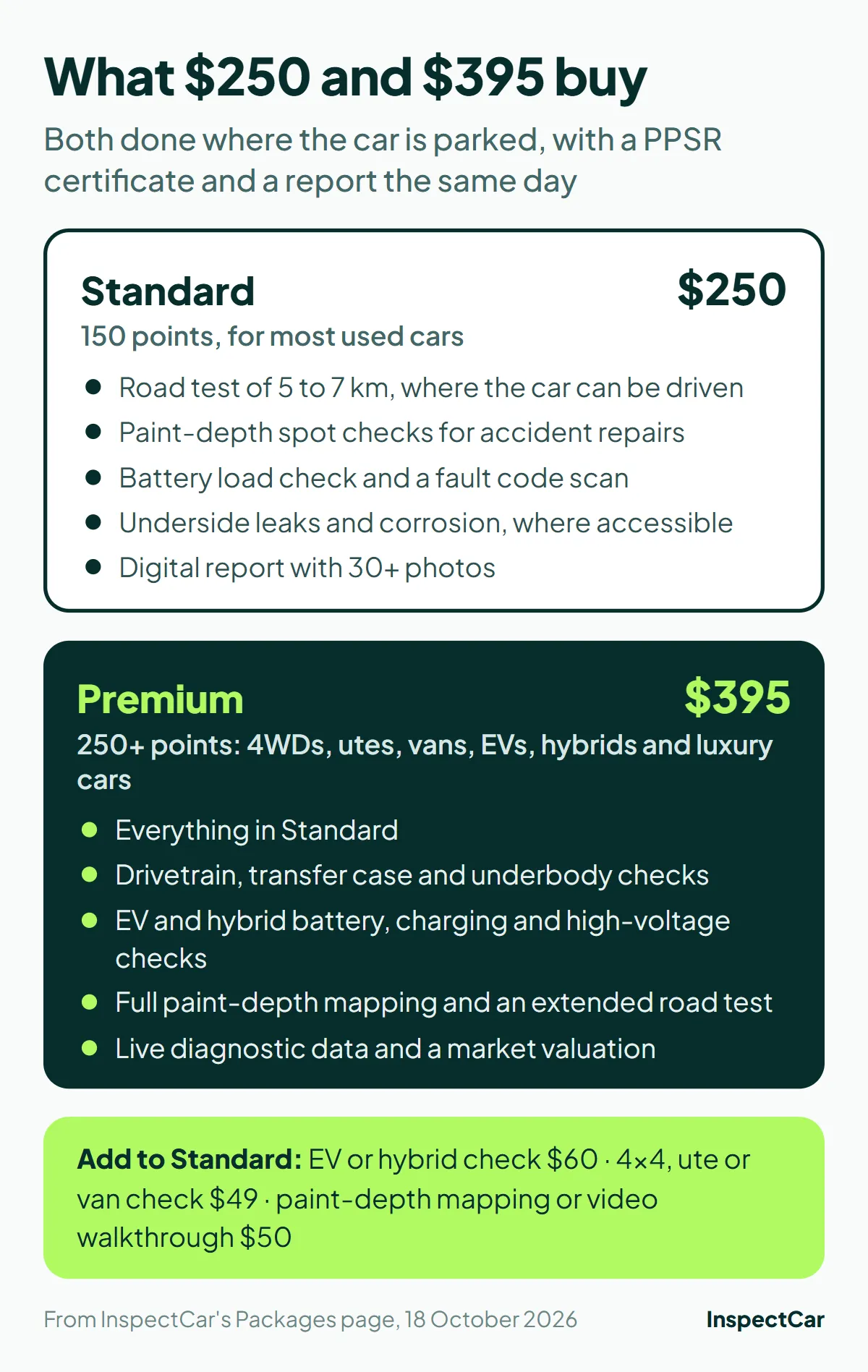
Is a pre-purchase car inspection worth it if it finds nothing wrong? We think so: you pay knowing the car’s condition, with a PPSR certificate in hand. Compare the two packages.
The Case Against Paying for One
The strongest argument against an inspection is a newer car from a licensed dealer, and it’s a fair one. Buy from a licensed dealer in Queensland and you get:
- a cooling-off period of 1 business day
- a class A statutory warranty of 3 months or 5,000 km on cars under 10 years old with under 160,000 km on the odometer
- a guarantee of clear title, so money owing on the car is the dealer’s problem
- access to a claim fund if you lose money because of the dealer’s actions.
Is a pre-purchase car inspection worth it on a two-year-old car from a dealer, still under the manufacturer’s warranty? Honestly, it’s optional. The same goes for a very cheap runabout you plan to drive into the ground, where $250 is a big share of the price.
Where the Dealer Argument Stops Working
The dealer protections have limits, and they’re easy to miss. The statutory warranty doesn’t cover defects in tyres, batteries, airbags, radiator hoses, most lights, paintwork or upholstery, among other items. Beyond that:
- cars 10 or more years old, or with 160,000 km or more, get a shorter class B warranty: 1 month or 1,000 km, and it doesn’t cover air conditioning
- caravans get no statutory warranty and no cooling-off period, even from a dealer (motorhomes generally do get the warranty), which is why a caravan inspection matters more than most
- consignment cars get neither, because the dealer is selling for a private owner
- at an auction there’s no cooling-off period, and you usually can’t test drive before bidding.
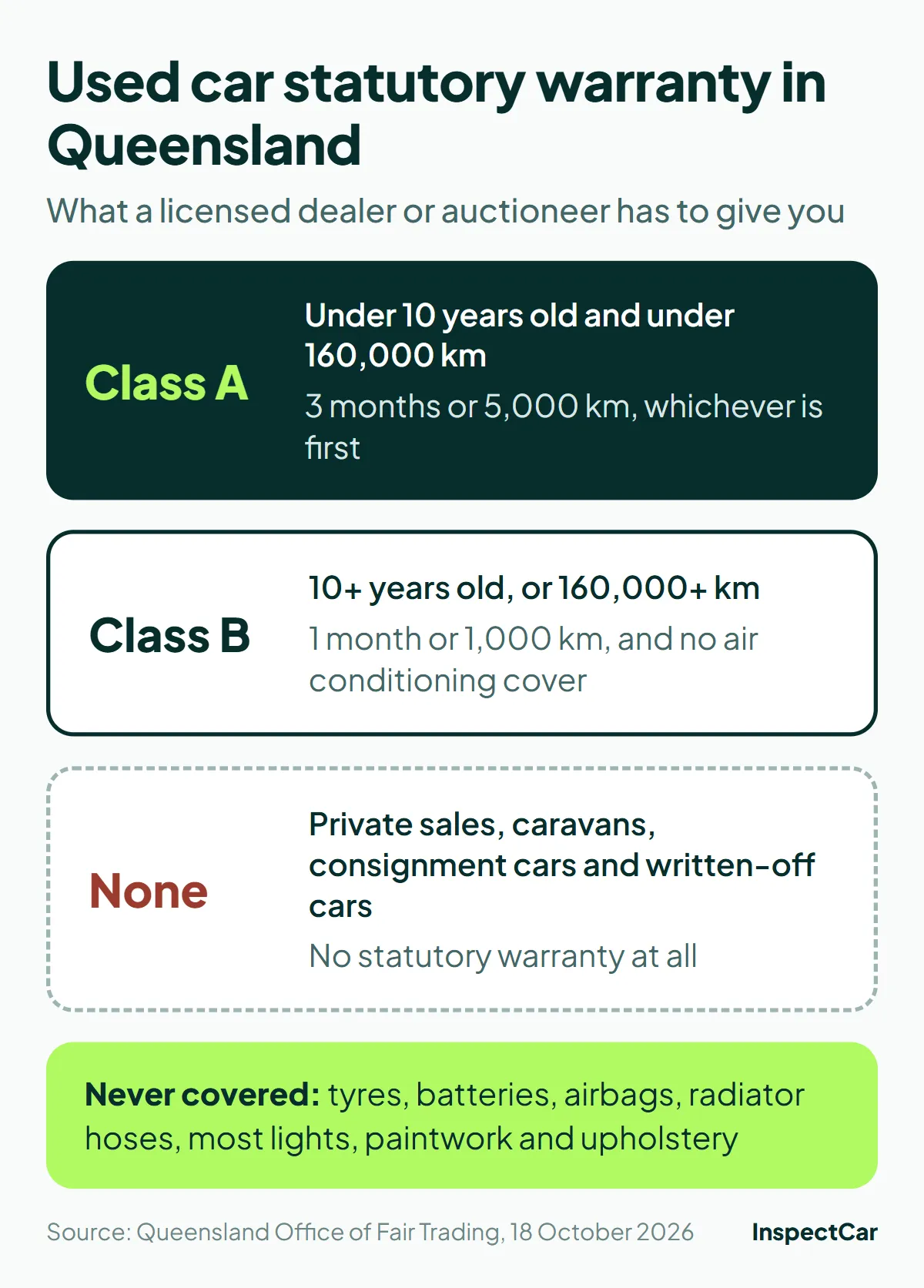
So is a pre-purchase car inspection worth it on an older dealer car, a consignment car, an auction car or a caravan? Our answer goes back to yes.
Is a Pre-Purchase Car Inspection Worth It on an EV, 4WD or Ute?
Yes, and often more than on an ordinary car, because these are the vehicles whose most expensive parts are hardest to judge on a test drive:
- Electric cars. The high-voltage battery is the most expensive part of an EV, and its condition decides how far the car goes on a charge. A test drive won’t tell you that. Premium checks battery health, the charging system and the high-voltage parts, and an Aviloo battery test adds a state-of-health certificate: $250 on its own, or $450 with Premium. More on our EV inspections.
- 4WDs. Towing, off-road driving and lift kits leave their marks underneath, on the drivetrain, the transfer case and the suspension. Premium checks those, or you can add a 4×4, ute or van check to Standard for $49. See our 4WD and SUV inspections.
- Utes and vans. A ute that has worked for a living may have carried heavy loads or towed for years, so the chassis, the tray and the tow bar matter as much as the engine.
- European and luxury cars. The electronics and suspension systems are costly to repair, and Premium checks them along with live diagnostic data where the car supports it.
Is a pre-purchase car inspection worth it on a hybrid? By the same logic, yes: the battery and the hybrid system are the costly parts, and Premium or the $60 EV and hybrid check covers them.
Should You Get One When Buying From a Dealer?
On a near-new car still under the manufacturer’s warranty, it’s optional. On any other dealer car, is a pre-purchase car inspection worth it? Usually, and the timing matters. The cooling-off period ends at 5pm on the dealer’s next business day, and taking the car to an independent mechanic for an inspection doesn’t end it, though driving it home does. Book the inspection before you sign, or inside that window, and you can still back out if the report finds something you can’t live with.
Before you sign, ask for the cooling-off form: a dealer who doesn’t give you one has to give you 7 days instead. If the car is on consignment, the dealer has to tell you, and there’s no cooling-off period to fall back on, so book the inspection before you sign. We do dealer and car yard inspections on the yard, so the car doesn’t have to go anywhere.
How to Make a Pre-Purchase Car Inspection Worth It
An inspection only helps if it happens before you pay. Four things make that easier:
- Ask the seller first. Most sellers have nothing to hide, and if one won’t allow an independent inspection, treat that as a warning sign.
- Book it before any deposit. If you can, agree in writing that the sale depends on a satisfactory inspection.
- Who pays for the inspection? Usually you, the buyer, because it’s done for you and not for the seller.
- Do you need to be there? No. A mobile inspector meets the car where it’s parked and sends you the report with photos the same day, which is how remote and interstate buyers check a car before they travel.
What an Inspection Can’t Tell You
An inspection shows the car’s condition on the day, and it has limits worth knowing before you pay for one:
- it can’t see inside the engine or gearbox without taking them apart, so it judges them by how they start, sound, leak and drive
- a fault that comes and goes may not show up on the day
- it can’t prove the odometer reading is genuine, although wear that doesn’t match the kilometres, or service records that disagree with them, are warning signs that go in the report
- on a mobile inspection the underside is checked where it can be reached, not on a hoist
- no inspection can say when a part will fail.
That’s why we report what we find, with photos, and leave the decision with you.
How to Use the Report to Negotiate
Use the findings, not a feeling. If the report shows worn tyres, an oil leak or a stored fault code, get a quote for the repair and ask the seller to take that off the price, or to fix it before you pay. Photos make that conversation easier, because the seller can see exactly what was found. Premium adds a market valuation and negotiation tips. And if the seller won’t move on a serious finding, walking away is still a good result: the inspection cost $250, not the price of the car. If you do buy, keep the report: it records the car’s condition on the day it became yours.
If You Skip It, Do These Four Things
Skipping the inspection doesn’t mean skipping every check. On a private sale, at the very least:
- Get a PPSR certificate yourself. It shows money owing, write-offs and stolen records.
- Check that the registration certificate matches the car and the seller: the owner’s name, the number plates, the VIN and the engine number. Check the build date on the car’s plates matches the advertised year, too.
- Make sure a registered car comes with a current safety certificate, and remember it covers basic safety items, not the health of the engine or gearbox.
- Transfer the registration into your name within 14 days of getting the car.
Wondering whether a mobile car inspection is worth it compared with taking the car to a workshop? Here’s how the two compare.
Where We Land
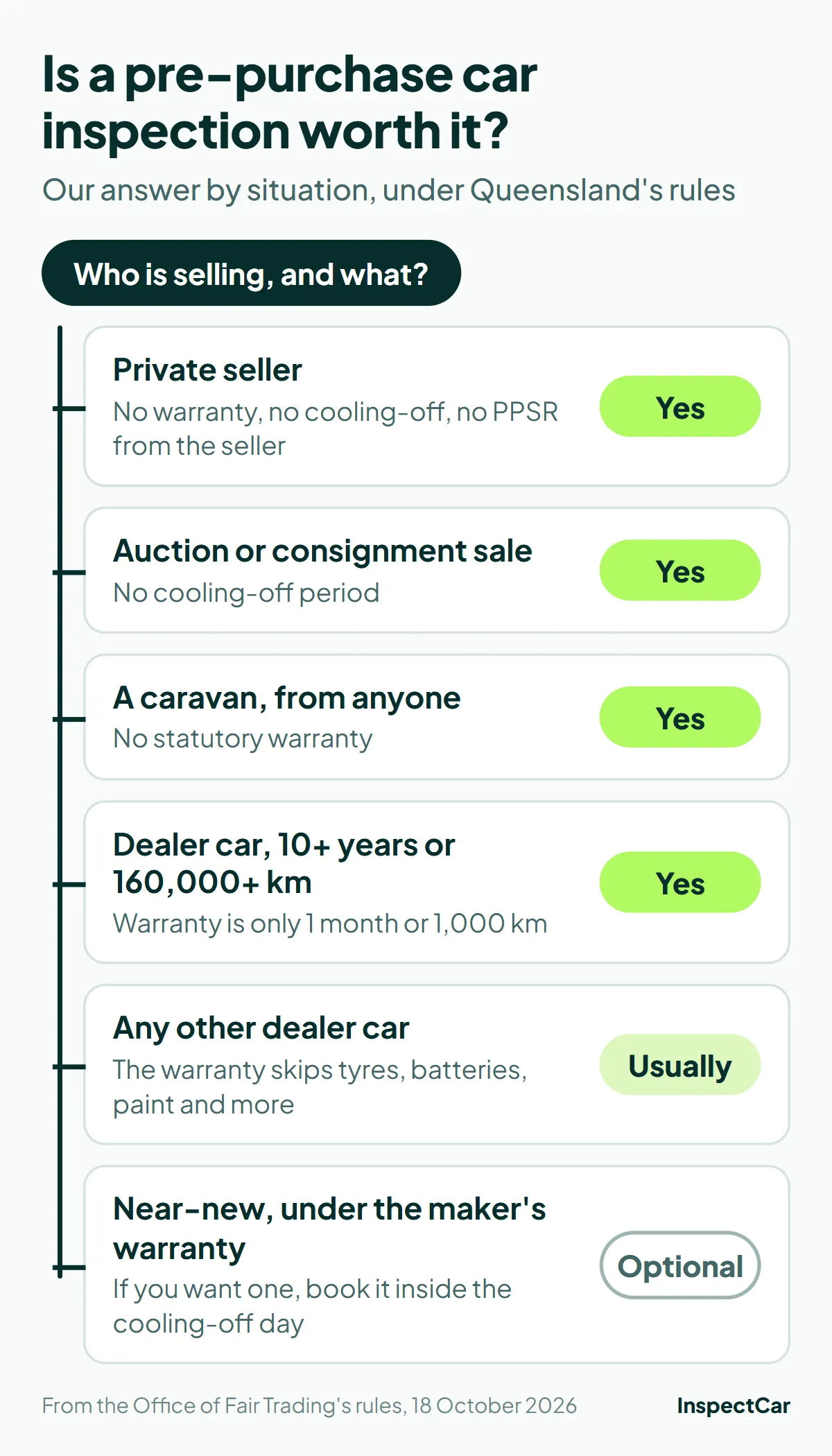
Is a pre-purchase car inspection worth it? For a private sale, an auction, a consignment car, an older dealer car or a caravan, we think so: those are the purchases where Queensland law leaves more of the risk with you. For a near-new dealer car still under warranty, it’s a judgement call, and we’d rather you knew that than book something you don’t need. Here’s the same answer as a chart:
If you’d like one, we inspect cars where they’re parked across Brisbane, the Gold Coast and the Sunshine Coast, with the report the same day. See what the report covers.