
Last reviewed: 27 October 2026
A used car inspection checklist takes you through a car in the order that finds problems fastest: the paperwork first, then the outside, the interior, under the bonnet, underneath, and finally a test drive. Ours has 110 points in seven stages, written for Queensland buyers, and the free PDF at the end prints on two pages. Start with the papers, because a car with an unclear history is a poor buy however good it looks. In Queensland that means a current safety certificate from the seller, a VIN that matches the registration certificate, and a PPSR search for money owing. Decide before you start that three serious red flags mean you walk away.
Before you start: this is general information about Queensland’s rules as they stood in October 2026, not legal or mechanical advice. We run InspectCar, a mobile pre-purchase car inspection service, so we have an interest in what you decide after reading it. The legal points below come from Queensland Government pages, which we link, and the checklist covers the same ground as our own inspection report.
Used Car Inspection Checklist: The Seven Stages
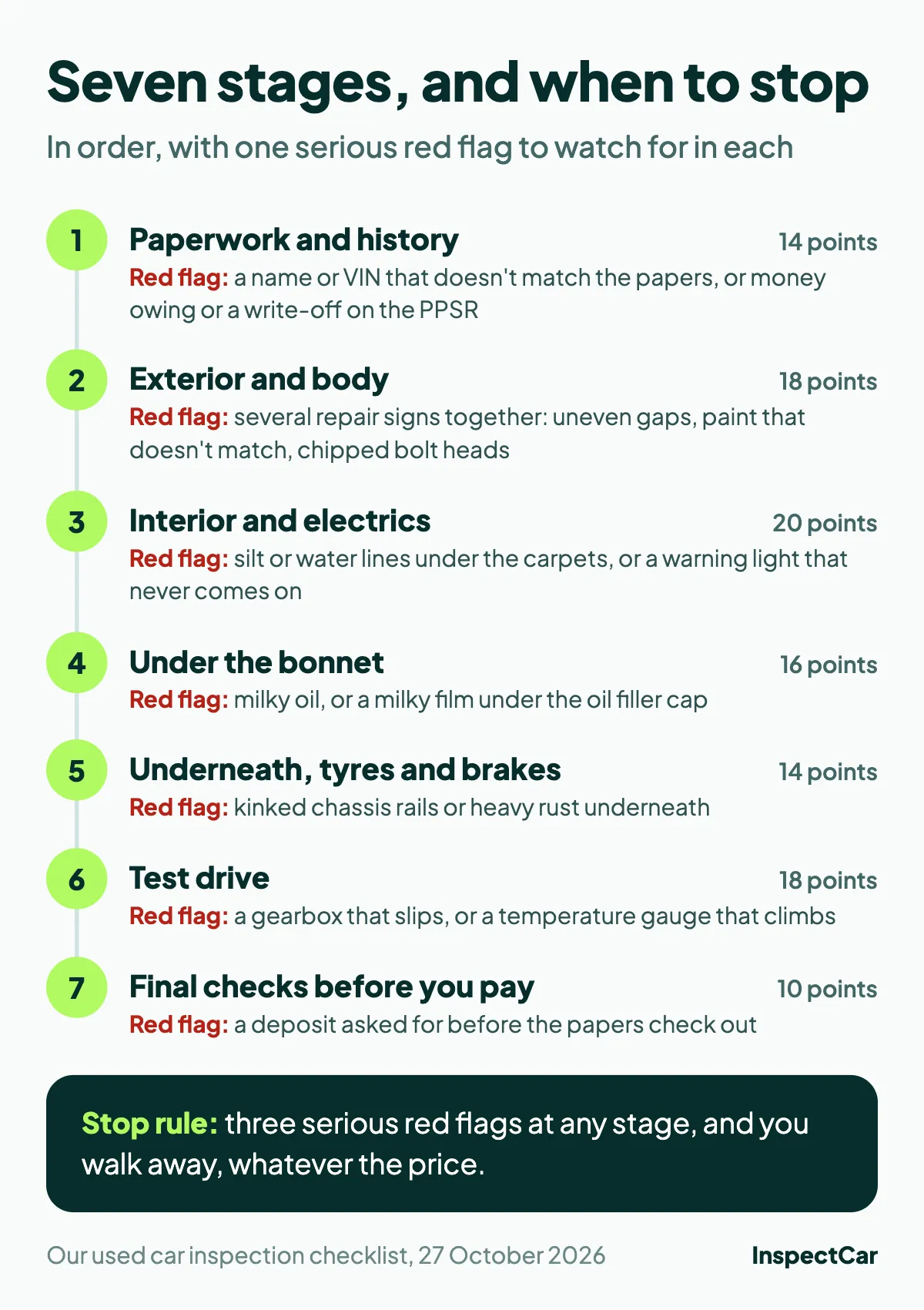
Work through the stages in order. A serious fault at an early stage is usually reason enough to stop, which saves you a test drive in a car you were never going to buy. The sections below group each stage’s points into a few lines, and the PDF lists all 110 with a tick box each.
| Stage | Points | What it tells you |
|---|---|---|
| 1. Paperwork and history | 14 | Whether the car can be sold to you, and whether it carries debt or a write-off |
| 2. Exterior and body | 18 | Past accidents, rust, hail and sun damage |
| 3. Interior and electrics | 20 | How hard the car has been used, and signs of flood or leaks |
| 4. Under the bonnet | 16 | Engine health on a cold start, leaks and overdue servicing |
| 5. Underneath, tyres and brakes | 14 | Wear that becomes your next repair bill |
| 6. Test drive | 18 | Gearbox, steering, brakes and suspension on the road |
| 7. Final checks before you pay | 10 | That the sale is clean and the car is legally yours |
What Should I Check When Buying a Used Car?
Check the paperwork before anything else, then the car from the outside in, and drive it last. A clean-looking car with an unclear history is still a poor buy, and the papers take ten minutes to check. After that, the order matters less than doing every stage in daylight, on a cold engine, without being rushed.
Set your stop rule before you arrive. Three serious red flags, such as names that don’t match, a warning light that won’t go out, or signs of flood damage, mean the inspection ends, whatever the price. Deciding it in advance makes it easier to walk away from a car you’ve already started to like. Our used car inspection checklist PDF prints the rule at the top of page 1.
What Documents Do I Need When Buying a Used Car in Queensland?
The key document is the safety certificate, once called a roadworthy certificate. A seller no longer needs one to advertise a registered car, but must have a current certificate to sell it, except to a dealer, and you can’t transfer the registration into your name without it. From a private seller it’s valid for 2 months or 2,000 km, whichever comes first, and from a licensed dealer for 3 months or 1,000 km, under the Queensland Government’s safety certificate rules. A seller needs a new certificate for every sale, so check its issue date and odometer reading against the car.
A safety certificate shows the car met minimum safety standards on the day: tyres, brakes, steering, lights and similar items. It isn’t a mechanical inspection, so it says nothing about the engine or gearbox. Our FAQ explains how a safety certificate differs from a pre-purchase inspection.
Ask to see, and check:
- the registration certificate, with a VIN and number plates that match the car’s VIN plate, as Transport and Main Roads advises when buying a used vehicle
- the seller’s photo ID, matching the registered owner’s name
- a PPSR search for money owing, a written-off record or theft. A private seller doesn’t have to give you one, so checking clear title is your job
- the service history: logbook stamps or receipts, with dates and odometer readings that add up
- a written receipt with the price, date, VIN, registration number and both parties’ details
- the transfer application, signed by you and the seller.
Once you’ve bought it, transfer the registration into your name within 14 days. Fees and vehicle registration duty change, so check the current amounts on the Queensland Government site before you pay.
How Do I Inspect a Used Car Myself?
You don’t need mechanical training to use a used car inspection checklist, but you need daylight, time and a few simple tools: the printed list, a torch, a small fridge magnet wrapped in a cloth (it won’t stick to body filler), paper towel for checking fluids, and a second person to watch the lights and listen. Don’t inspect in the rain or after dark, because both hide paint and panel faults. Ask the seller not to start the car before you arrive: a cold start shows problems a warm engine can hide.
How Long Does It Take to Inspect a Used Car?
Allow 30 to 45 minutes for the checks and another 20 to 30 for the test drive. If you’re short of time, do the paperwork, a walk around in daylight, a cold start and a short drive, and leave the rest to a professional inspection. A professional one takes longer, and our guide to how long a pre-purchase car inspection takes explains why.
Exterior and Body (18 Points)
The first physical stage of the used car inspection checklist is a slow walk around the car before you touch anything. Then look along each side from a low angle.
- Panel gaps that are even on both sides of the bonnet, doors and boot
- Paint that matches between panels in daylight, with no orange-peel texture and no overspray on rubber seals or badges
- Rust at the wheel arches, sills, door bottoms, boot edges and around the windscreen
- Hail dimples on the roof and bonnet, which show when you look along them from a low angle
- Chips or cracks in the windscreen, and glass markings that differ from window to window, a sign of replaced glass
- Cloudy headlights, moisture inside the lenses, and every light working (your helper checks the brake lights)
- A tow bar, which means the engine, gearbox and suspension may have worked hard
Queensland sun is hard on paint. A faded clear coat or a chalky bonnet tells you the car has lived outdoors, which matters more for the price than for safety.
Interior and Electrics (20 Points)
The interior often tells you more about a car’s life than the odometer does, which is why it’s the longest stage of the used car inspection checklist.
- Wear that doesn’t match the distance: a shiny steering wheel and worn pedals on a car showing 60,000 km don’t add up
- A musty smell, or heavy air freshener, which can hide leaks or smoking
- Silt, water lines or rust on the seat rails, under the carpets and in the spare-wheel well, which point to flood damage
- Every warning light coming on when you turn the key, then going out once the engine starts. A light that never comes on may have been disconnected
- Seatbelts that pull out fully, lock on a sharp tug and wind back cleanly
- Air conditioning that blows properly cold within a couple of minutes
- Windows, mirrors, central locking, every key and remote, the reverse camera, parking sensors, the screen and the USB ports
Electric and hybrid cars need extra checks on the high-voltage battery and charging, which a driveway look can’t cover. Our EV pre-purchase inspection page explains what we test.
Under the Bonnet (16 Points)
Do this stage of the used car inspection checklist with the engine cold, and keep your hands clear of the fan.
- Engine oil between the dipstick marks and amber to dark brown. Milky oil, or a milky film under the filler cap, can mean coolant is getting into the oil
- Coolant at the right level, clean and without an oily film. Only open the cap when the engine is cold
- Brake fluid and, where fitted, power steering fluid within their marks
- Belts and hoses without cracks, fraying, bulges or soft spots
- No fresh oil or coolant leaks on the engine, the gearbox or the ground below
- A timing belt replaced on schedule, if the engine has one: the service records should show it
- A cold start that fires promptly, with no long cranking, rattles or knocking, and no blue or white smoke once the engine is running
Underneath, Tyres and Brakes (14 Points)
Bring the torch for this part of the used car inspection checklist, and start with the tyres.
- Tread above the wear indicators on all four tyres, worn evenly across each one. Uneven wear usually points to alignment or suspension problems
- No cracks, cuts or bulges in the sidewalls, and a date code on each tyre under about six years old
- A spare tyre, jack and wheel brace that are all there and usable
- Brake discs without deep grooves or a heavy lip at the edge
- Each corner bouncing back once and settling when you push down hard on it
- Underneath, with a torch: no heavy rust, no kinked chassis rails, no fresh underseal in odd places and no loose exhaust mounts
On a 4WD, also check the underbody for off-road damage and the transfer case and differentials for leaks. Our 4WD pre-purchase inspection page covers the rest.
What Should I Look for on a Used Car Test Drive? (18 Points)
The test drive is the last big stage of the used car inspection checklist. Drive for at least 20 to 30 minutes if the seller agrees, on slow streets, a faster road, a hill and a rough surface, with the radio off. Check first that you’re covered by the seller’s insurance.
- Steering that sits centred and doesn’t pull to one side or vibrate at speed
- An automatic gearbox that changes smoothly, without jerks, slips or flaring revs. On a manual, a clutch that bites around the middle of the pedal
- Brakes that stop the car straight, with a firm pedal and no pulsing or grinding
- No clunks over bumps, no humming that rises with speed and no knocking when you accelerate
- A temperature gauge that stays steady near the middle, even in traffic with the air conditioning on
- No warning lights during the drive, and an easy restart once the engine is warm
Afterwards, park, leave the engine running and check underneath for fresh drips.
How Can I Tell if a Used Car Has Been in an Accident?
Many repaired cars are fine, but you should know the history before you agree on a price. Look for:
- uneven panel gaps, or a door or bonnet that sits proud of the panel next to it
- paint that doesn’t match between panels in daylight, or overspray on seals and trim
- bolts on the guards, bonnet or doors with chipped paint, which shows they’ve been undone
- glass markings that differ between windows
- uneven tyre wear, even after a recent wheel alignment
- a written-off record on the PPSR search.
One sign on its own proves little. Several together are a reason to walk away, or to have the car checked with a paint-depth gauge, which measures where the paint has been redone.
What Are the Red Flags When Buying a Used Car?
- a seller who rushes you, or says another buyer is on the way
- no daylight viewing, or no independent inspection allowed
- a seller whose name doesn’t match the registration certificate
- a request for a deposit before you’ve seen the papers
- a VIN plate that looks tampered with, or doesn’t match the papers
- a price far below similar cars for sale.
Should I Get a Professional Inspection Before Buying a Used Car?
For most used cars, yes. This used car inspection checklist rules out the obvious problem cars, and it’s worth doing on every car you look at. But some faults only show with tools a buyer doesn’t carry: a scan for current and stored fault codes, paint-depth readings, a battery load test, a proper look underneath and a longer road test. Queensland’s Office of Fair Trading also tells private buyers to get an independent vehicle inspection before they buy.
That’s where InspectCar fits in. Our inspectors come to the car, at the seller’s home, a dealer or an auction yard across Brisbane, the Gold Coast and the Sunshine Coast. The Standard inspection covers 150 points for $250, with a PPSR certificate and a report with photos the same day, and our guide to what a pre-purchase car inspection costs covers Premium and the add-ons. The report covers the same ground as this checklist, the exterior, tyres, mechanical, interior and a road test, plus a fault-code scan and a 4WD section where it applies. Use the checklist to pick the car, then book an inspection on the one worth buying. The report also gives you facts to negotiate with.
Private Sale Used Car Checklist: Before You Pay (10 Points)
A private sale has no cooling-off period and no statutory warranty, so these last checks on your used car buying checklist matter most:
- run the PPSR search again on the day you pay, not a week before
- check the safety certificate is still current that day
- agree the price in writing, allowing for any faults you found
- pay by bank transfer and keep the record, rather than carrying cash
- pay only after you and the seller have signed the transfer application
- collect every key, the logbook and the service records
- arrange insurance from the moment the car is yours.
Buying from a private seller or on Facebook Marketplace? Our private sale inspection page covers the extra risks.
Free Printable Used Car Inspection Checklist PDF
Our used car inspection checklist PDF is a used car checklist Queensland buyers can print and take to the car. It has all 110 points as tick boxes on two A4 pages, spaces for the VIN, the odometer reading, the price and the seller’s details, a list of what to bring, and room for notes and your offer. Tick as you go. It’s a do-it-yourself list, not an InspectCar inspection report: when we inspect a car, you get our own report with photos and the inspector’s findings.
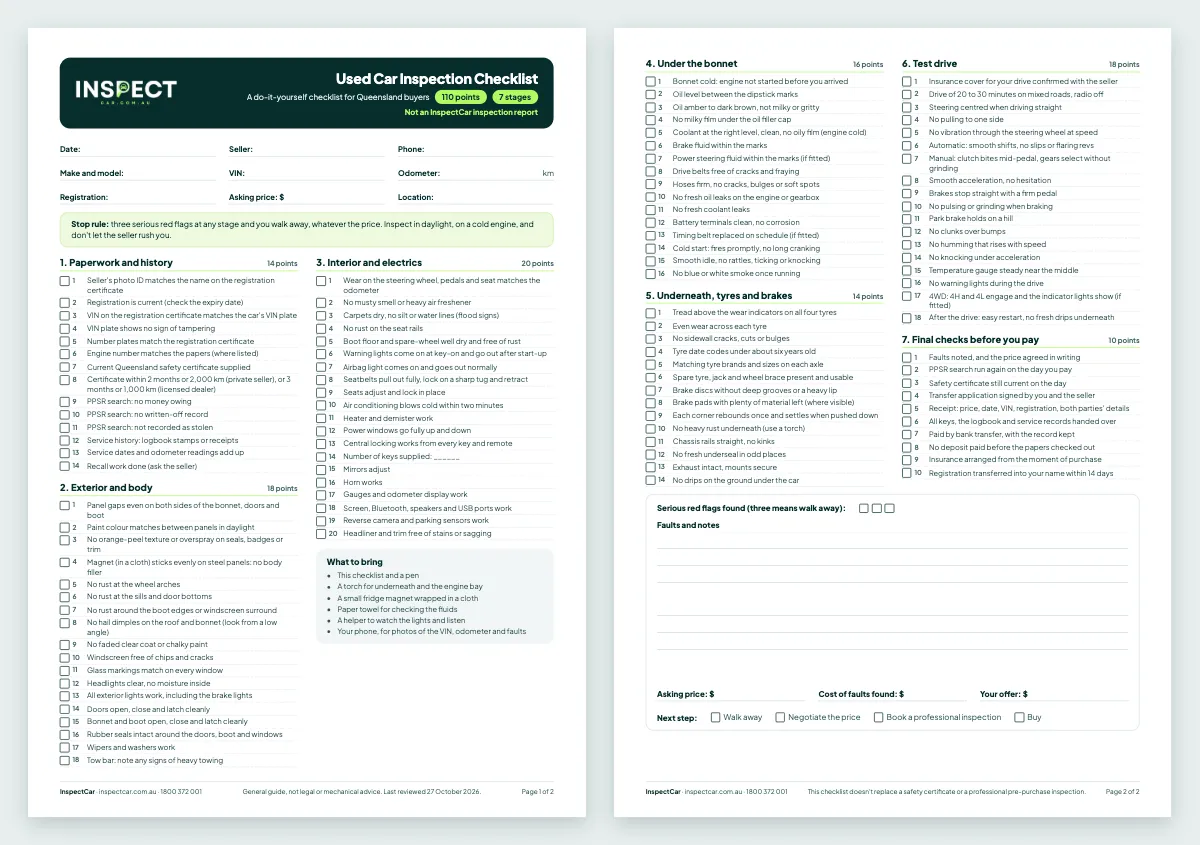
Download the free used car inspection checklist (PDF, 2 pages)
Frequently Asked Questions
What should I check when buying a used car?
Start with the paperwork, then check the outside, the interior, under the bonnet, underneath and the tyres, and finish with a test drive in daylight. A used car inspection checklist keeps you to that order.
What documents do I need when buying a used car in Queensland?
A current safety certificate from the seller, a registration certificate that matches the car, a PPSR search, the service records, a signed transfer application and a written receipt.
How do I inspect a used car myself?
Use a printed checklist, a torch and a magnet, work through the car in order and in daylight, and finish with a drive of 20 to 30 minutes.
What are the red flags when buying a used car?
A seller who rushes you, names or VINs that don’t match, no service history, a price far below similar cars, or a refusal to allow an independent inspection.
Should I get a professional inspection before buying a used car?
Usually, yes. A safety certificate isn’t a mechanical inspection, and a professional inspection adds a fault-code scan, paint-depth readings and a battery test that a driveway check can’t.
How long does it take to inspect a used car?
About 30 to 45 minutes for the checks, plus 20 to 30 minutes for the test drive.
What should I look for on a used car test drive?
Steering that runs straight, smooth gear changes, brakes that stop straight, no odd noises, a steady temperature gauge and air conditioning that blows cold.
How can I tell if a used car has been in an accident?
Look for uneven panel gaps, paint that doesn’t match, bolts with chipped paint, glass markings that differ and uneven tyre wear, then check the PPSR search for a written-off record.
The Short Version
A used car should save you trouble, not start it. Take your time with the used car inspection checklist, set your stop rule before you arrive, and be ready to walk away. When you’ve found the one worth buying, an independent inspection tells you what the checklist can’t.